
Get Support
07496822205
What is laminated HDF?
-
 By: Ethan
- July 20, 2026
If you’re looking for materials for furniture, doors, wall panels, or interior use, you might have heard of laminated HDF.
What Is It, and How Is It Different From Ordinary HDF?
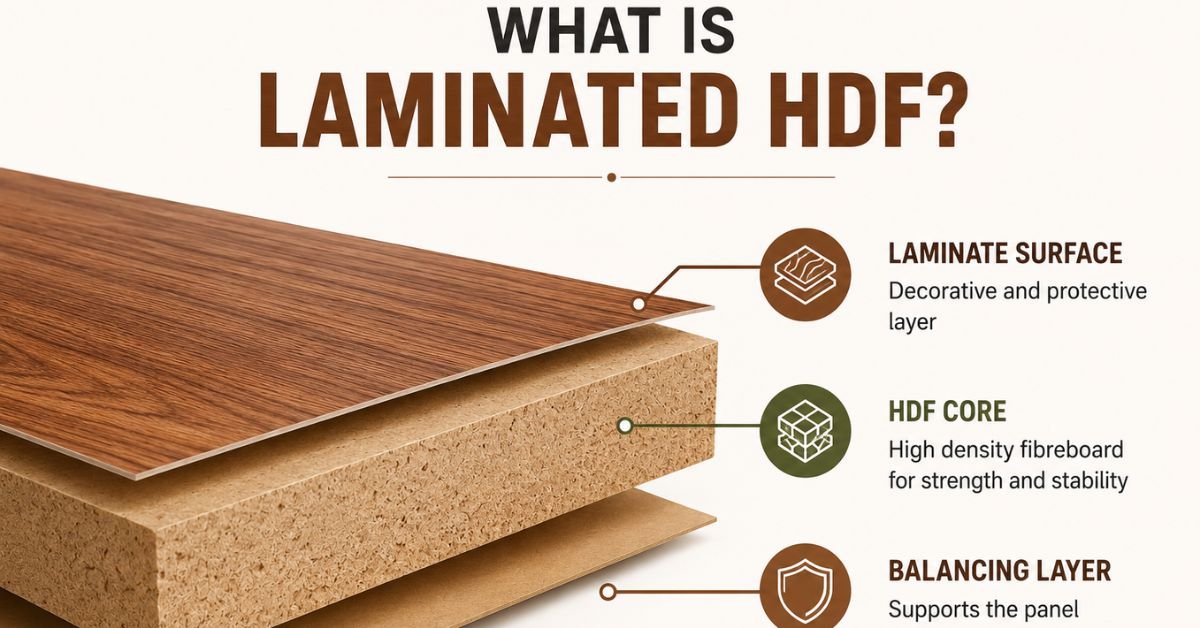
HDF is the acronym for High-Density Fibreboard, an engineered wood panel formed by subjecting wood fibres to heat and pressure and binding them with resin. It is dense and uniform, with a smooth, hard surface suitable for various interior uses.
A decorative laminate can be attached to the top of the HDF to form a laminated HDF board. The laminate surface gives the laminate a finished appearance and also contributes to the protection of the surface, making the board ideal for use in situations where both appearance and
How is laminated HDF made?
The first step is to refine the wood fibres and add bonding agents. The fibres are then compressed under high pressure and temperature, which results in a uniform and compact HDF panel. After the base board is finished, a decorative laminate or surface can be installed over it to achieve a desired colour or texture, or to achieve the appearance of wood grain. Usually, HDF is used in furniture parts, decoration, door skins, decorative panels, laminate floors, etc.
The most important benefit of this construction is its uniformity. HDF does not have knots or irregular grain patterns like natural wood, which means a more consistent surface and finished product can be produced.
What are the advantages of Laminated HDF?
Laminated HDF Board is a combination of the dense core of HDF and a finished decorative surface. This is helpful if you want to have a clean look but do not want to use a separate finish after installation.
It has several advantages, such as:
Laminated HDF, however, is not necessarily waterproof. When exposed to water, particularly around unprotected edges and damaged surfaces, Standard HDF swells.
Laminated HDF Board is suitable for furniture components, decorative wall panels, interior doors, flooring systems, and other interior applications where a clean, durable, and finished surface is required.
For areas that may be exposed to moisture, it is important to check the product specifications before use. Not all laminated HDF boards are moisture-resistant, so the selected product should be specifically designed and tested for moisture-prone applications.
Conclusion
Laminated HDF is a dense engineered wood board covered with a layer of decorative material. It has a good balance of the following attributes: appearance, surface durability, consistency, and design flexibility for many interior applications. The right Laminated HDF Board should always be chosen based on the area in which it is to be installed and the amount of moisture and wear and tear it is expected to endure.
For a quality interior panel solution, you can contact Crosta Panels to discuss your application and design needs and determine the appropriate type of panel that can be used.
FAQs
1. What’s the difference between laminated HDF and MDF?
Typically, No. HDF is denser and harder than MDF, but this depends on the product specification.
2. Will laminated HDF get wet?
When it comes to waterproofing, standard HDF should not be used as the material. When exposed at edges and in damaged areas, water can cause swelling.
3. Is it possible to make furniture from laminated HDF?
Yes. The use of HDF for furniture components and decorative interior applications (where the board specification meets the use) is acceptable.
4. Which finishes can be used with laminated HDF?
The laminated surfaces may come in various colors, patterns, textures, and wood-like finishes, depending on the manufacturer.
5. What is the advantage of using laminated HDF?
It features a high-density, uniform engineered-wood core and a pre-made surface finish, making it effective for products where both look and utility are important.