
Get Support
07496822205
Black MDF and Laminated MDF Understanding the Better Choice
-
 By: Ethan
- February 26, 2026
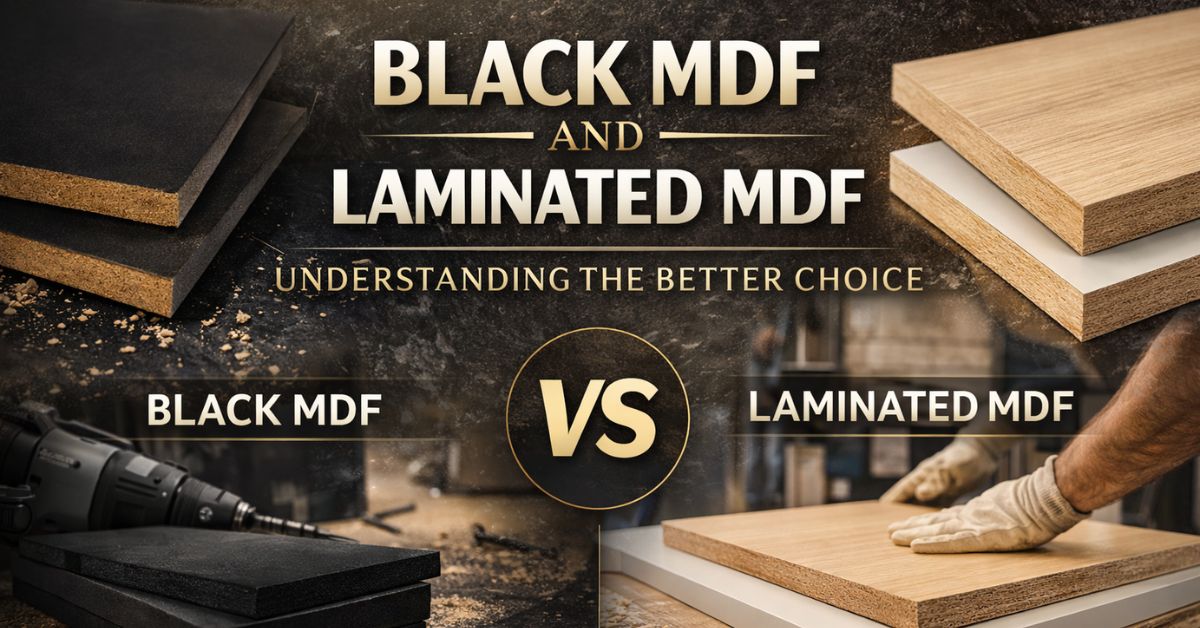
The right board material can make significant changes to the end result, in terms of appearance, durability and performance of your interiors. Regardless of whether you are doing modern furniture, shop displays, modular kitchens or partitions you will find two popular ones; black MDF or laminated MDF. They are both commonly utilized, both cheaper than solid wood, and even more versatile in interior use.
Nonetheless, they are not the same. Knowing the true differences can enable you to make more accurate judgments, avoid unnecessary mistakes and achieve a result that achieves your design goals. Today, we are going to cover all you should know about the Black MDF Board and laminated MDF.
Understanding MDF Prior to Comparing Anything
Before comparing black MDF and laminated MDF, it's vital to define MDF.
MDF (Medium Density Fibreboard) is a manufactured wood product produced by refining hardwood or softwood into fine fibres, which are then bonded with resin and compressed under high temperature and pressure to form a strong, smooth board.
MDF is popular because it is:
- Smooth and homogeneous in texture.
- Simple to cut, drill, and shape.
- Cost-effective as compared to plywood and solid wood.
- Ideal for painting, laminating, and veneering.
Understanding the MDF base makes it easier to determine the differences between black and laminated MDF.
What is MDF that is black?
MDF that has black pigment added into the wood fiber during manufacturing is known as black MDF. If this is done, the board will be completely black.
This indicates that the core and the surface are both black, giving it a consistent high-end look.
Sometimes, a black MDF board is utilized when the design calls for:
- Modern, dim interiors
- Clean edges without visible raw MDF
- Exquisite furniture finishing
- Premium showroom setups
A Black MDF Board's most obvious characteristic is that its exposed black regions stay black regardless of how the board is cut, routed, or shaped.
What is Laminated MDF?
Standard MDF with a laminate sheet applied to one or both sides is called laminated MDF. Adhesives and industrial pressing techniques are used to adhere the laminate. Laminated MDF is not colored throughout, in contrast to black MDF. The surface is ornamental, but the interior is still the same shade of brown MDF.
The layer of laminate offers:
- Beautiful design details
- Resistance to scratches
- Protection from stains
- Simpler cleaning
Due to its ready-to-use nature, laminated MDF is frequently utilized in large-scale projects and modular furniture.
Appearance and Visual Impact
Appearance is one of the biggest deciding factors when choosing between these boards.
The appearance of a black MDF board
A black MDF board has a rich, consistent tone that seems sophisticated and of high quality. Because the entire board is black, it gives a polished appearance even in exposed or unfinished parts.
It is suitable for rooms where black is part of the design motif, such as:
- Contemporary wardrobes
- Luxury shelving systems
- Display Units
- Decorative panels
- Retail and showroom furnishings
It gives a clean, bold, and basic appearance that is consistent with modern architectural trends.
Laminated MDF Appearance
Laminated MDF provides more options because laminate sheets are available in a range of finishes, including:
- Wood grains (oak, walnut, teak)
- Marble and Stone Textures
- Colours that are solid and matte
- Glossy luxurious colors.
- Fabric and leather textures
This makes laminated MDF ideal for situations in which style flexibility is more important than a solid core colour.
Black MDF Board Edge Advantage
Because the board is black throughout, the edges stay black after cutting. This makes it visually beautiful without requiring extensive edge treatment. Exposed edges on modern furniture can look purposeful and quality, which is why Black MDF Board is popular in high-end interior designs.
Laminated MDF Edge Requirement:
Laminated MDF requires edge banding because the inner MDF core becomes apparent when the board is cut. Without edge banding, the furniture appears unfinished.
Edge banding can be achieved using:
- PVC Edge Tape
- Acrylic edging
- Wood veneer edging.
While edge banding improves beauty, it adds an extra step, costs more, and may wear out over time.
Surface durability and scratch resistance.
Black MDF Durability
Black MDF is sturdy and stable, but its surface durability is determined by the finishing method employed. If left untreated, it is prone to scratching. However, when completed with coatings such as PU paint, polish, or lacquer, it becomes extremely durable and suited for high-end furniture.
This makes Black MDF Board a fantastic choice for designer furniture projects that include surface finishing.
Laminated MDF Durability
Laminated MDF is naturally more scratch-resistant because the laminate layer is intended to protect the board surface.
This is why laminated MDF is commonly used in:
- Kitchen cabinets
- Office furnishings
- Tables for study
- Storage units.
Laminated MDF frequently performs better in high-traffic areas without requiring additional surface covering.
Moisture resistance and water exposure
MDF is not inherently waterproof, although performance varies depending on surface treatment and protection.
Moisture performance of black MDF board
If a regular black MDF board is exposed to moisture over an extended period of time, it will swell, particularly at the edges.
Moisture-resistant black MDF is available for humid settings. Proper sealing and coating can also help to improve moisture management.
Moisture performance for laminated MDF
Laminated MDF features a protective surface layer, making it more resistant to slight water contact than bare MDF.
Moisture can still infiltrate though:
- Unsealed edges
- Screw hole
- Joints
- Laminate surfaces are damaged.
Laminated MDF is suitable for kitchens and bathrooms if the edges are adequately sealed.
Cost Comparison
Black MDF Board Cost
Black MDF is normally more expensive than standard MDF since it contains coloring and is considered a luxury interior material. Furthermore, if you want coating or painting, the final project cost may rise.
Laminated MDF CostLaminated MDF can be more cost effective because it is ready-to-use, lowering finishing expenditures. For large-scale modular furniture production, laminated MDF is frequently the less expensive option.
Which is better for premium interiors?
In case the objective is to design modern rooms that have luxurious impression, Black MDF Board is usually favorable as it has permanent black core and good edge finish. Instead, Laminated MDF is more appropriate to furniture that is used every day and requires durability and easy cleaning more important than a smooth edge look. As a matter of fact, the most ideal solutions often include the two materials, based on furnishing needs.
Final Verdict: Black MDF vs. Laminated MDF
The distinction between black MDF and laminated MDF boils down to design priorities.
Black MDF Board is ideal for high-end furniture finishing, exposed edges, and premium aesthetics. Laminated MDF is ideal for long-term durability, surface protection, and cost-effective large-scale use.
Both are wonderful materials, but the best decision depends on the type of project, planned usage, moisture exposure, and desired interior concept. When picking the perfect board for modern furniture, premium interiors, or modular projects, finding the right provider is just as important as choosing the correct material.
For high-quality Black MDF Board and reliable MDF panel solutions that meet professional interior standards, connect with Crosta Panels today.